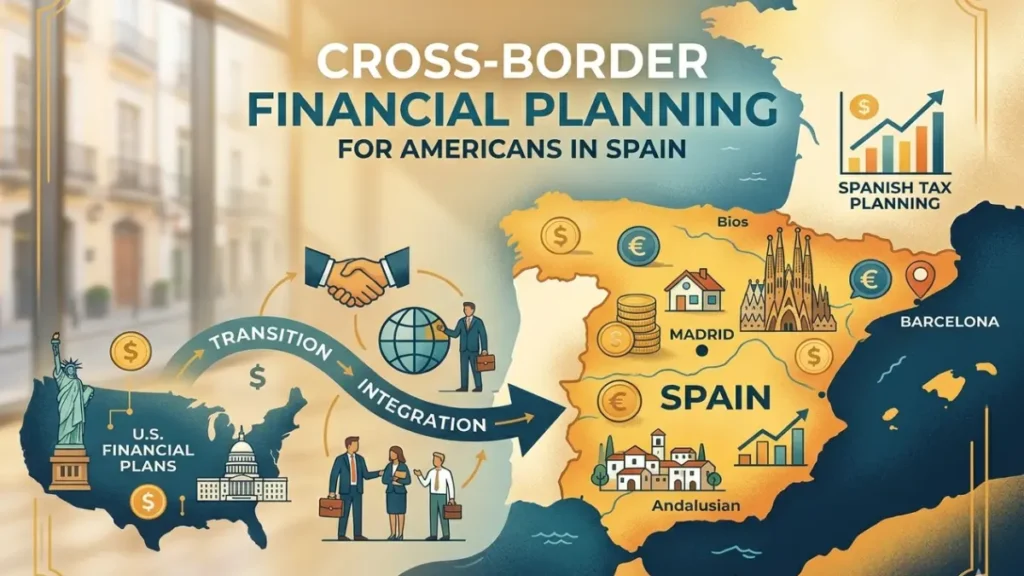
Before moving to Spain, John and Trish followed the advice of their financial planner in Boston. It was good advice—at least in the United States. But once they moved and became Spanish tax residents, this guidance became problematic and inefficient. Trish laughs when she admits: “bringing along that old financial plan was like taking a snow shovel to the beach.”
Their situation isn’t unusual. Many Americans arrive in Spain believing that a financial plan developed in the United States will continue to work abroad. But for the important changes that confront Americans who move to Spain, they seldom do.
The rules are different in Spain
Once an American becomes a Spanish tax resident, the rules change in ways that many U.S.-based advisors simply don’t anticipate. Spain has its own tax system, reporting requirements, and investment rules. Spain also imposes something Americans often find surprising: a “wealth tax” (Impuesto sobre el Patrimonio), which is based on the net worth of individuals rather than on their income. Unlike income tax, which is based on what a person earns each year, this tax applies to the total net value of assets owned by a taxpayer.
Read Also: Best way to Invest in Spain
U.S. rules continue to apply
Americans living in Spain still need to file taxes with the IRS every year. Living abroad means new rules and additional reporting requirements such as FBAR and Form 8938 in the U.S. and Modelo 720 in Spain.

It may also mean getting a crash course in Passive Foreign Investment Company (PFIC) rules of the IRS. Many Americans living in Spain buy PFICs unintentionally and only discover the issue if their U.S. tax preparer asks about foreign funds. These rules were originally made to prevent U.S. investors from deferring tax by investing in offshore funds. Unfortunately, they now affect numerous Americans simply because they live abroad.
Most non-U.S. investment funds -including European mutual funds – are considered PFICs. When an investment is classified as a PFIC, it is often subject to complex reporting requirements and unfavorable tax treatment, including higher taxes and interest charges on gains.
This is where cross-border planning becomes necessary.
Cross-Border Financial Planning: U.S. Expats in Spain
Following the rules of two financial systems and two tax authorities at the same time makes their financial life much more complex than that of typical Spanish tax residents or expats from countries with residence-based taxation. None of this means Americans in Spain can’t create a strong financial plan. It simply means that planning needs to take both systems into account.
The good news is that with the right financial planning, these problems are often avoidable. Understanding how U.S. and Spanish rules interact can help expatriates make smarter decisions about investments, retirement planning, and long-term financial strategy.
That’s why Americans who live in Spain increasingly look for advisors who understand both sides of the equation.
Peter Dougherty
If John and Trish are lucky, they’ll meet Peter Dougherty. He’s the financial planner at Bissan Wealth Management who is Wall Street-trained, Spanish-speaking, Ivy League-educated, and certified as a financial planner in both Spain (EFP) and the United States (CFP®). He’s also the author of two books on cross-border financial planning: “The Dougherty Code: Secrets of Financial Planning in Spain Revealed” and “La Ruta de Hoja Fiscal y Financiera para los españoles en EE.UU.”
As a financial planner working with Americans in Spain, I regularly help clients review their existing U.S. strategies and adapt them to their new situation. Trying to stick with their old financial plan after they move is a bit like continuing to use a sunscreen that only works on cloudy days.”
To schedule a free consultation with Peter Dougherty:
Read Also:Nvidia’s Stock Price Rise Amid Growing Concerns Over AI Bubble