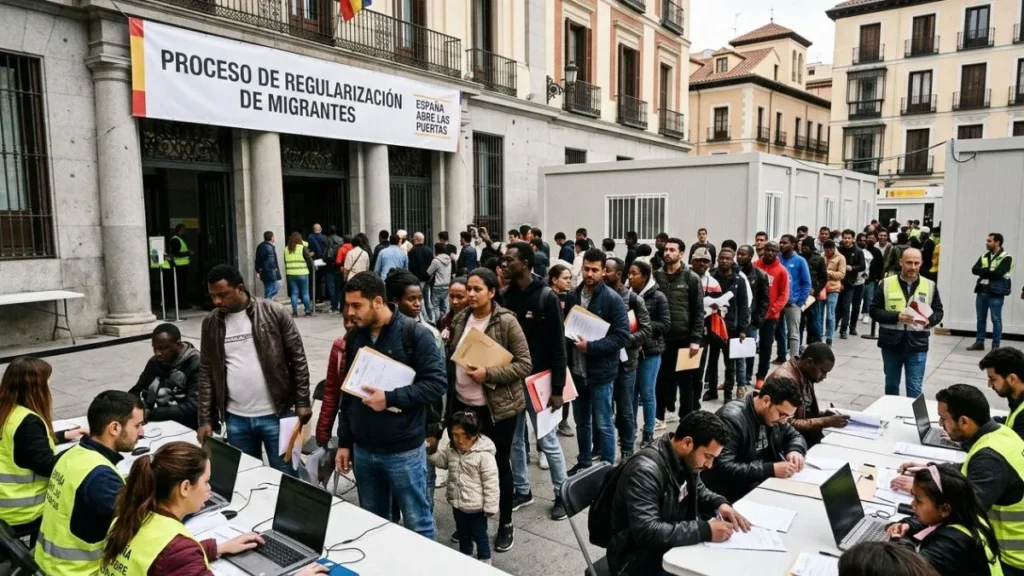
MADRID —Long queues formed outside post offices, social security buildings, and city halls across Spain on Monday as hundreds of thousands of undocumented migrants began the formal process of claiming legal residency under a landmark government amnesty program — one that positions Spain as a bold outlier in an increasingly anti-immigration Europe.
The program, which was announced in January and formalized by royal decree earlier this month, grants eligible applicants a one-year renewable residence and work permit. To qualify, migrants must have been living in Spain before December 31, 2025, demonstrate at least five months of continuous presence in the country, and carry no criminal record. The window to apply closes at the end of June — giving hundreds of thousands of people roughly ten weeks to gather documents and submit applications.
Scenes From Day One
The response was immediate and overwhelming. In Barcelona, migrants waited hours outside City Hall just to collect the paperwork needed to begin their applications. In central Madrid, families arrived together at designated post offices, hoping to secure their place in a new chapter of their lives.

Among them was Johana Moreno, a Venezuelan woman who trained as an archivist in her home country but has spent years cleaning homes in Spain. She arrived with her husband and spoke plainly about what legalization means to her family. “It’s what we want,” she said. “To be well, to work, to contribute, all those things. To pay our taxes. We know that we’ll have rights, but also we’ll have obligations.”
Her words echoed the government’s own framing of the program — not as charity, but as a mutual compact between the state and those who already contribute to its economy.
The Numbers Behind the Policy: 500,000 Migrants Explained
The Spanish government estimates around 500,000 people are eligible under the scheme. However, independent research paints a larger picture. The Funcas think tank places the total undocumented population at approximately 840,000, the vast majority from Latin America — with significant numbers from Colombia, Peru, and Honduras. Internal police estimates suggest applications could ultimately exceed one million.
Over 370 post offices have been designated as application centers, alongside 60 social security offices and several dedicated migration offices nationwide.
Official Voices on X
Prime Minister Pedro Sánchez framed the decree as both a moral and economic imperative in a post on X, writing: “Neither technology nor automation will solve this challenge on their own in the coming years. The path is clear: better integration, better organisation, and channeling the full potential of those who already live among us.” He called the measure an “act of justice and a necessity.”
Immigration Minister Elma Saiz took to X to counter critics who warned the measure would fuel job competition among Spanish workers. “Regularization is not competition. It is social justice and visibility. It is giving opportunities,” she wrote on the day applications opened.
Saiz had earlier emphasized the economic logic driving the policy, stating that “our prosperity is demonstrably linked to our management of migration and the contributions of foreign workers,” adding that their labor enables Spain to “grow economically, generate employment and wealth and maintain our welfare system.”
Spain Against the Grain
The measure was pushed through via executive decree, bypassing a parliament where Sánchez’s coalition lacks a majority and where a previous legislative attempt at amnesty failed. Critics from the conservative People’s Party and the far-right VOX party argue the program will incentivize further irregular migration. Civil servants have also raised concerns about whether existing infrastructure can process such a volume of applications within the compressed timeline.
Yet the government has remained firm. Spain’s foreign-born population now exceeds 10 million — more than one in five residents — and key industries including agriculture, hospitality, and domestic services run substantially on migrant labor. With an aging population and one of the fastest-growing economies in the European Union, officials argue the country simply cannot afford to keep half a million productive workers in legal limbo.
This is Spain’s seventh mass legalization program since the 1980s. Whether it becomes a model for the rest of Europe — or a political lightning rod — remains to be seen.
Sources: Al Jazeera
Read More: 1 British Tourist Killed in a Tragic Bus Crash in the Canary Islands