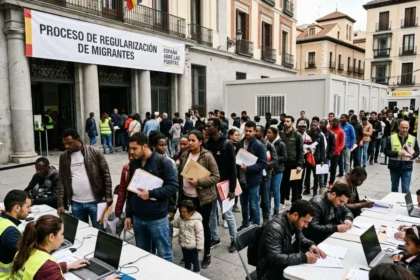
Spain, October 15, 2025 – Spain is going against the current trend in the West to tighten borders by being extra beholden to the African migration. The Spanish cabinet is going to double the “circular migration” program, which will give the West Africans short-term seasonal work permits. The scheme not only aims to cope with the poverty of the major sectors of the Spanish economy but also to support the legal migration in very much the same way.
Expanding Circular Migration and Regularisation Efforts
Spain’s circular migration program allows West African workers to obtain temporary visas valid for up to 9 months within a 12-month period. These workers can enter Spain legally to work in agriculture and other seasonal industries before returning home. The program that was previously initiated has now been carried on and expanded through the government of Prime Minister Pedro Sánchez in 2025 with the main goal of migration that is safe and organized.
Based on government statistics, around 300,000 undocumented migrants will yearly be given regular status in Spain from 2025 to 2027, thus granting legal rights to over a million migrants in total within three years. This measure is a part of a wave of reforms that began in May 2025 and is aimed at making it easier for people to enter the country legally by cutting down on the number of bureaucratic barriers. One of the main changes is that the period during which migrants can live in Spain and become eligible for legal status has been reduced from three years to two years.

Empowering Lives with Justice
Throughout the years, migrants have been making up about 13.5% of the total Spanish workforce and accounted for 40% of the total new job creation in 2024, with the largest number of jobs in the fields like construction, agriculture, and healthcare. Spain, like the rest of Europe, is currently dealing with an aging population and a shrinking young workforce, hence the necessity of having legal channels for the admission of African migration workers if the economy is to grow in the future.
Around 56,000 migrants entered Spain via sea in 2024, with the Canary Islands being the receiving point with the highest number of arrivals. Despite the challenges that the government is facing as a result of this migration flow, it is deciding to focus on formal labor market integration rather than informal economies for these people. And this is quite the opposite of the situation in some other European countries where the major emphasis is still on border control and deportations.
Restorative Justice and Support for People of African Descent
Moreover, Spain is steadily implementing steps that if done properly would take a long time to completely cover and the African migration community and people of African descent will heal from their wounds both ancient and modern. On October 14-16, 2025, the Spanish capital will host AFROMADRID 2025, a world conference on the subject of restorative justice for African descent people. Besides, the conference has already attracted more than 200 international experts, activists, and policymakers to ponder on topics like reparations, social transformation, and inclusion.

In this case, restorative justice means committed actions that target reversing the effects done by the historical injustices of racism, colonialism, and discrimination. The conference pointed out the necessity for policies that would not only heal but also empower, thereby shifting the focus from merely regarding the African descent individuals as putting them in the victim category. Spain is going to set up a special development fund dedicated to the support of social and economic projects for the African communities in both Spain and African countries.
This entire dedication to social justice goes hand in hand with Spain’s migration reform, thus forming a comprehensive framework that humanizes the migrant experience while nurturing the cooperation of the Spanish and African governments. The Spanish authorities’ participation in these restorative operations is in concert with the pleas from the international bodies for the full acknowledgment and protection of the rights of people of African descent.
Key points to consider:

- Spain plans to regularize 300,000 undocumented migrants annually between 2025-2027 (total over 1 million).
- Migrants comprise 13.5% of Spain’s workforce and filled 40% of new jobs in 2024.
- The number of migrants who came by sea in 2024 was 56,000, a record high since 2018.
- Temporary seasonal work visas granted to West African workers allow stays up to 9 months within 12 months.
The combination of the progressive migration policies along with the restorative justice measures, in fact, gives Spain a landmark position in 2025. The double-sided approach is, on the one hand, meeting the immediate labor market requirements and, on the other hand, dealing with the long-term social issues related to Africa’s past and the diaspora’s realities. The inclusive policy puts Spain at the forefront of the very consistent migration solutions that are built on respect, opportunity, and mutual development.
Also Read: Trump Threatens Tariffs on Spain Over NATO Defense Spending Defiance